
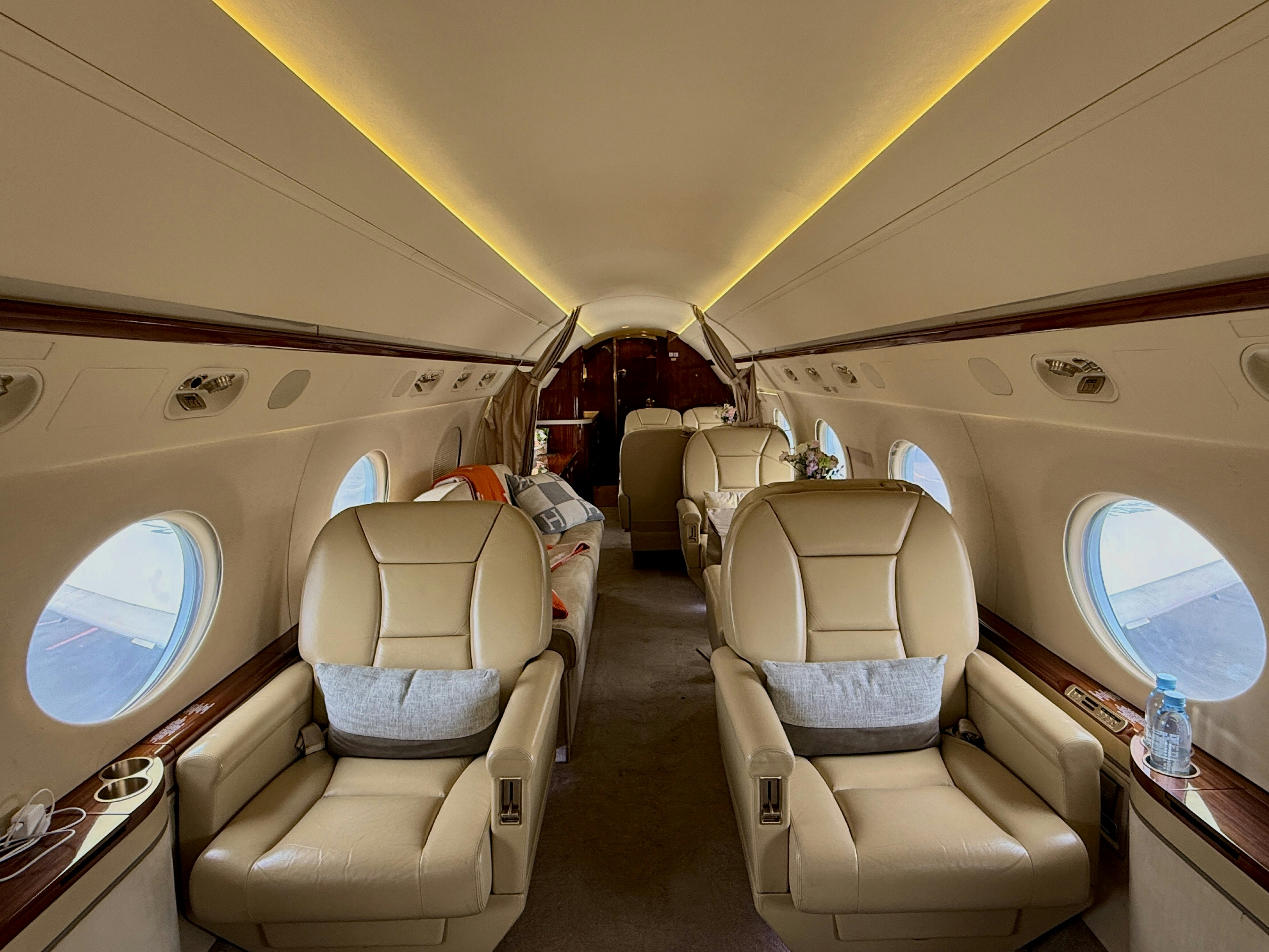
There is a particular kind of luxury that announces itself through absence: no fingerprint on the polished trim, no forgotten cup in the galley, no trace of yesterday's itinerary on today's cabin. It looks effortless. It is, in fact, the result of small decisions made at the right time.
For an owner, the interval between professional details can be weeks. For a busy flight department, it may be a succession of arrivals, departures and quick turns. Both face the same challenge: how to protect fine materials without asking the crew to become a detailing department. The answer is a disciplined, deliberately limited between-visit routine.
That interval is the real test of an appearance-care standard. A cabin can leave a hangar in impeccable condition and still face the ordinary hazards of use before the next scheduled service: a coffee cup set on a veneered table, hand lotion transferred to a pale armrest, rain carried across a threshold, or a hurried galley reset at the end of a long duty day. None is dramatic on its own. Together, these moments determine whether the next professional visit begins with routine refinement or a list of preventable problems.
The owner's question is therefore larger than how often to detail the aircraft. It is who recognizes the small change, who knows the approved response, and who is accountable for following through when the right response is to stop. The difference between a beautiful aircraft and a consistently cared-for aircraft is often found in that chain of judgment.
Preservation is not the same as restoration
The most valuable action after a flight is often the least dramatic. Remove food waste, collect loose debris, look for spills and note anything unusual. These actions prevent avoidable exposure and give the professional care team an accurate starting point. They do not require a cabinet full of chemicals.
Restoration begins where routine care should stop. A stain in perforated leather, residue on an unfamiliar coating or moisture near sensitive equipment deserves documentation and an approved response, not an improvised attempt to make the mark disappear before the next passenger boards. Overzealous rubbing can do more harm than waiting for a trained professional.
Consider the difference between removing an empty cup and treating the ring it has left on a finished table. The first is straightforward housekeeping. The second may involve a finish whose construction and approved cleaning method are not obvious to the person holding the cloth. The responsible decision can be to isolate the concern, record its location and refer it to an authorized specialist. That decision may feel less satisfying in the moment, but it protects both the surface and the operator's options.
An effective care plan divides work into three lanes. Routine stewardship covers observations, waste removal and other expressly permitted tasks. Professional appearance care covers the approved, documented cleaning and finish-preservation scope assigned to trained providers. Maintenance or repair decisions remain with the appropriately authorized aviation personnel. These lanes should meet through communication, but they should not be blurred by enthusiasm or a tight turnaround.
The cabin is not one material
A modern aircraft interior may place leather, veneer, plated metal, engineered stone, textiles, polymers, touchscreens and specialized transparencies within a few feet of one another. The label on a household cleaning product cannot tell an operator whether it is compatible with all of them.
The National Business Aviation Association's aircraft-cleaning resources repeatedly direct operators to the aircraft and component manufacturers' guidance. That matters because a product suitable for a galley worktop may be inappropriate for a display, leather finish or flight-deck control. Even familiar microfiber cloths should be clean, dedicated to the correct task and used only where the prescribed method permits.
Build the onboard care kit around a documented list of approved products and materials for that aircraft—not around what happens to be available at the FBO. Label containers clearly. Replace contaminated cloths. Keep cleaning supplies secured in their designated storage location. If a crew member cannot identify the correct procedure, the appropriate next step is to ask.
There is a useful distinction between an approved product and an approved application. Even when a material appears on an operator's list, that does not necessarily make it suitable for every surface, concentration or delivery method. A treatment intended for one finished panel may not be suitable for adjacent trim or an electronic display. The FAA's aircraft-interior disinfection bulletin illustrates the stakes: chemical selection and frequency can have airworthiness implications, including corrosion and effects on electrical systems. Its pandemic-era context does not make the underlying compatibility question disappear.
For each commonly encountered surface, the flight department should be able to find a short answer to four questions: what may be used, how it may be applied, who may perform the task and when it must be escalated. A one-page aircraft-specific reference, kept current with the applicable OEM and component instructions, is far more valuable than a generic shopping list. A new aircraft, refurbished cabin or changed product formulation deserves a fresh review.
A ten-minute arrival ritual
Begin at the entry and walk the cabin in a consistent order. Check the galley for liquid or food residue; scan armrests and tables for marks; remove waste; inspect floor areas and lavatory surfaces for issues requiring attention. Do not apply products indiscriminately. Make a short record of anything that cannot be addressed within the aircraft's approved routine.
That record can be exceptionally simple: date, aircraft, location, observation, action taken and whether a specialist needs to follow up. A photograph can help when it is safe and appropriate to take one. For a fleet, consistent terminology allows different crews and service providers to act on the same information without guessing what 'needs attention' meant three flights earlier.
The sequence matters. First, secure the cabin under the operator's normal post-flight procedures; no appearance task should compete with safety, security or required flight duties. Next, remove loose waste and check the obvious spill-prone zones—galley work surfaces, tables, seat surrounds and entry areas—using only established permissions. Finally, make one deliberate visual pass for exceptions. Is there a new mark, a recurring odor, an unfamiliar residue, a damaged edge or moisture where it should not be? The purpose is to find and report, not to treat everything that is noticed.
Imagine a flight crew seeing a faint mark on a light leather armrest. A weak process says 'clean the seat' and leaves the next person to interpret the instruction. A stronger one records the side of the cabin, the exact seat and armrest, the appearance of the mark, the time observed and whether anything was applied. If the authorized care method is unknown, the record should explicitly say 'no treatment attempted.' Such precision gives the next provider a clean starting point and prevents accidental layering of incompatible products.
This routine need not become paperwork for its own sake. The objective is a brief, repeatable handoff that survives a schedule change. One minute of accurate context may be worth more than ten minutes of well-intentioned guesswork.
Disinfection requires a separate decision
Cleanliness and disinfection are related, but they are not synonyms. The FAA has warned that inappropriate or excessive disinfectant application can affect airworthiness through corrosion, material degradation or electrical problems. Product efficacy is only one part of the decision; aircraft compatibility, application method and manufacturer instructions are equally important.
This is why a well-designed routine specifies who is authorized to carry out enhanced cleaning and when it should be escalated. Never assume that a stronger concentration, a longer soak or repeated spraying constitutes more responsible care.
It is helpful to separate three questions that are often bundled together. Is a surface visibly clean? Is disinfection necessary for the circumstances? And, if it is, is the chosen product and procedure compatible with this particular aircraft component? The EPA's product guidance explains that disinfectant effectiveness depends on following the registered label, including the required wet-contact time. That public-health requirement does not override aircraft manufacturer restrictions. Both conditions have to be satisfied before the task is undertaken.
An owner should never have to discover after the fact that a treatment was improvised because the schedule was demanding. If the approved method cannot be completed within the access window, the team needs a safe escalation route—not permission to shorten contact times or substitute chemicals. The strongest service culture gives people authority to report a limitation before it becomes damage.
Make the condition record part of the next service
The most useful notes do not remain buried in an email thread. Before the next professional detail, the aircraft manager or designated coordinator should review open observations, identify any required technical decision and share only the relevant information with the care provider. That pre-visit brief might say that a galley edge has a recurring mark, a particular trim finish has restricted products, or one passenger area needs a condition assessment before treatment. It should also identify the permitted access window and the person who can approve a change in scope.
At completion, distinguish three outcomes: work performed, a concern observed but not treated, and a follow-up action requiring a named owner. Those categories make the history useful. They also prevent a clean-looking cabin from being mistaken for proof that every reported issue was resolved. Privacy matters as well; photographs and notes should follow the operator's rules for passenger information, aircraft identifiers and access to records.
Over several visits, this history becomes a form of preventive intelligence. A recurring scuff at an entry point may suggest a handling habit or protective measure worth reviewing. Repeated residue in a galley area may reveal a process issue rather than a need for stronger chemistry. The goal is not to assign blame. It is to see the pattern early enough to change the routine.
The thirty-day standard an owner can actually inspect
Begin with a short conversation among the aircraft manager, lead crew member and appearance-care provider. Agree which tasks are routine, which require qualified treatment and which must be referred for technical review. Confirm the current aircraft-specific material guidance and remove any ambiguous or unapproved supply from the routine kit.
During the first week, trial a concise post-flight observation form and determine where open items will live. During the second, compare the notes with the next professional-service brief. In the third, review whether the crew is being asked to do too much or whether useful observations are being lost. At the end of the month, select one recurring condition and change the underlying process that contributes to it. These are illustrative management steps, not a substitute for an operator's manuals or required procedures.
The scorecard should be simple: are observations specific, are exceptions routed to the correct authority, and are unresolved items visible at the next handoff? A cabin's beauty is a result; the quality of these decisions is the system behind it.
The detailer's best ally is information
An exceptional detail is not merely the final appearance of a cabin. It is the continuation of a care history. The owner who reports a new stain before it is treated, or the crew who identifies a recurring high-wear area, helps protect the aircraft's finishes and informs the next visit.
Good care is cumulative. Done well, the quiet minutes between flights preserve the experience that a professional detail creates. They also make the next detail more precise, more efficient and better suited to the aircraft itself.